Why Milk Supply Differs So Much Between Mamas
Some Mamas make milk easily, others struggle. What really determines supply, which worries are myths, and which signs deserve attention.

Someone in your antenatal group is leaking through two breast pads. You have spent three days convinced you are not making enough.
The difference is real. What causes it is widely misunderstood, and that misunderstanding makes a lot of Mamas stop sooner than they needed to.
Supply runs in two phases, and the handover confuses everyone
The first phase is hormonal. Your milk comes in because the placenta has been delivered and progesterone dropped sharply. It happens automatically, even if your baby has not fed at all. That is why almost everyone gets the fullness at day 3 to 5.
The second phase is demand-led. Around the second week, control shifts. From then on your body makes as much milk as is removed from it. Not what your baby needs, not what you hope for. What comes out is the order your body fills.
That handover explains a very common pattern. Milk feels abundant in week one, then seems to reduce by week three. Usually production has not fallen at all. Your body has simply stopped producing automatically and started waiting to be asked.
What actually determines it
How often milk is removed. The biggest factor by a distance. Your breasts read demand: more often and more completely removed, stronger signal to make more. Milk left sitting sends the opposite signal, and there is a substance in milk itself that suppresses production when it accumulates.
Eight to twelve times in 24 hours in the early months is what keeps the system running.
How effectively it is removed. Frequency alone is not enough if each session drains you poorly.
A shallow latch is the usual reason. A baby gripping only the nipple, rather than a good mouthful of areola, works hard and transfers little. It hurts, she stays hungry, and your body reads it as low demand.
Signs worth checking: pain right through the feed, a nipple that comes out flattened or wedge-shaped, clicking sounds, and a baby who feeds for very long stretches without ever seeming satisfied.
One session with a lactation consultant often resolves what has felt for weeks like not enough milk.
The glandular tissue you have. The one difference between Mamas that no technique changes.
Breasts contain fatty tissue and glandular tissue. Only the glandular kind makes milk, and how much you have varies, with no relationship at all to breast size.
A small number of Mamas have underdeveloped glandular tissue. Signs include widely spaced breasts, a tubular shape, marked asymmetry, and most tellingly, breasts that did not grow at all during pregnancy. No amount of effort changes anatomy, and it deserves assessment by a professional rather than more trying.
Medical causes that get missed. Retained placenta, keeping progesterone high. Thyroid disorders, relatively common after birth. Heavy bleeding during delivery. Previous breast surgery, particularly where ducts or nerves were cut. PCOS. Some hormonal contraceptives, especially oestrogen-containing ones started early.
What looks like a problem and usually is not
Most Mamas who feel their supply is low are producing plenty. What changed is the signals.
Your breasts no longer feel full. Production settling to match demand, usually around week six. Not a decline.
She feeds more often. Growth spurts raise demand for a few days. She is ordering more, and your supply is keeping up.
Pump output is small. Pumps are not babies, and they never were.
Feeds are shorter. Older babies get far more efficient.
The two measures that actually mean something: weight gain following her curve, and enough wet nappies, around six or more a day after the first week.
What helps
Fix the latch first. The biggest return, and it costs nothing.
Remove milk more often, not for longer. Adding a session beats extending one.
Offer both sides, and offer the first side again at the end.
Eat and drink enough. Breastfeeding needs real additional energy, and restrictive dieting in the early months is one of the most avoidable causes of a drop.
Rest where you can. Deep exhaustion interferes with oxytocin release, which is the hormone governing how milk gets out.
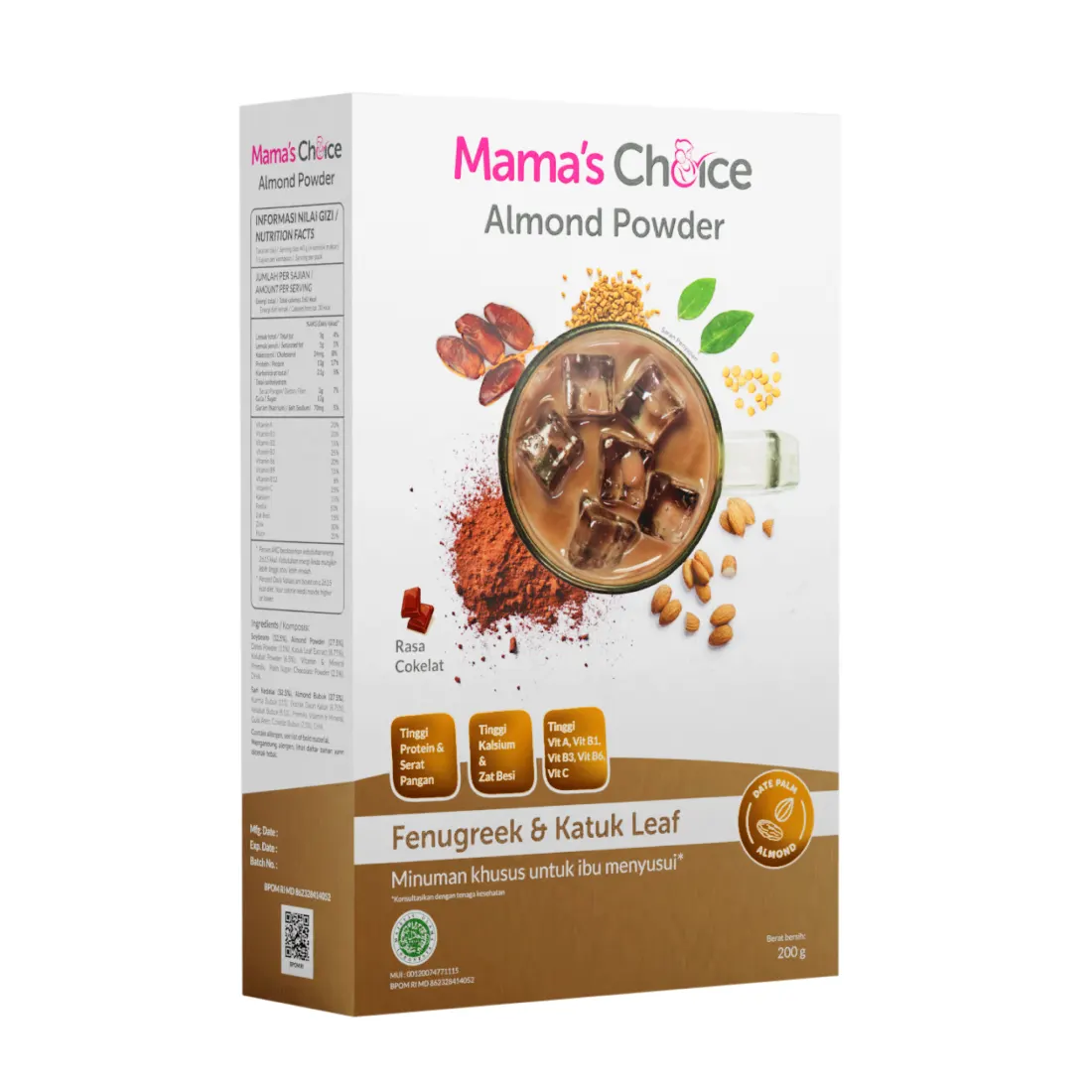
Some Mamas also use supportive ingredients such as fenugreek, almond, dates and katuk leaf, the basis of Almond Milk Powder. In our 2022 satisfaction survey of 60 Mamas using the ASI Booster capsules, 90% felt they helped support milk production and 95% felt their milk seemed thicker. Perception results from a satisfaction survey, and best understood as complementary to removing milk often enough.
Ask for help if
- She has not regained her birth weight by two weeks
- Fewer than six wet nappies a day after the first week
- She is very sleepy and hard to wake for feeds
- Feeding hurts right through
- Your breasts did not change at all during pregnancy or after the birth
Asking early is almost always easier than repairing later. And a supply that differs from someone else's is not a measure of how well you are mothering.
Frequently asked questions
- Does breast size determine how much milk I make?
- No. Breast size is mostly fatty tissue, while milk is made by glandular tissue. A Mama with small breasts can produce just as much as one with large breasts.
- How much milk should I get when I pump?
- Pump output is not a measure of supply. Babies are usually far more effective at removing milk than a pump. Many Mamas with ample supply get only 50–100ml per session, and that is normal.
- Can some Mamas genuinely not make enough milk?
- Yes, though it is uncommon. Causes include underdeveloped glandular tissue, thyroid problems, retained placenta, or previous breast surgery. If you suspect this, see a lactation consultant or doctor rather than concluding it alone.
- When does supply settle down?
- Usually around four to six weeks, when production switches from hormonal control to demand-led control. After that, how often milk is removed becomes the main factor.
Sources
- Mama's Choice — consumer satisfaction survey 2022, n=60
- World Health Organization — guidance on exclusive breastfeeding
Share this article
This article is for information only and is not a substitute for diagnosis or medical advice. Please discuss your own situation with your midwife or doctor.