Choosing a Baby Bottle for a Breastfed Baby
Teat shape, flow rate, material and venting decide whether a bottle complements breastfeeding or competes with it. A practical guide.

Twenty bottles on the shelf, and the same question behind all of them: if I give her this, will she still take the breast?
Fair worry. Four things decide it, and none of them is the price.
About nipple confusion
It happens when a baby gets used to a bottle that is much easier to drink from. Fast flow, milk arriving without effort, and then a breast that expects her to work turns into a fight.
What lowers the risk:
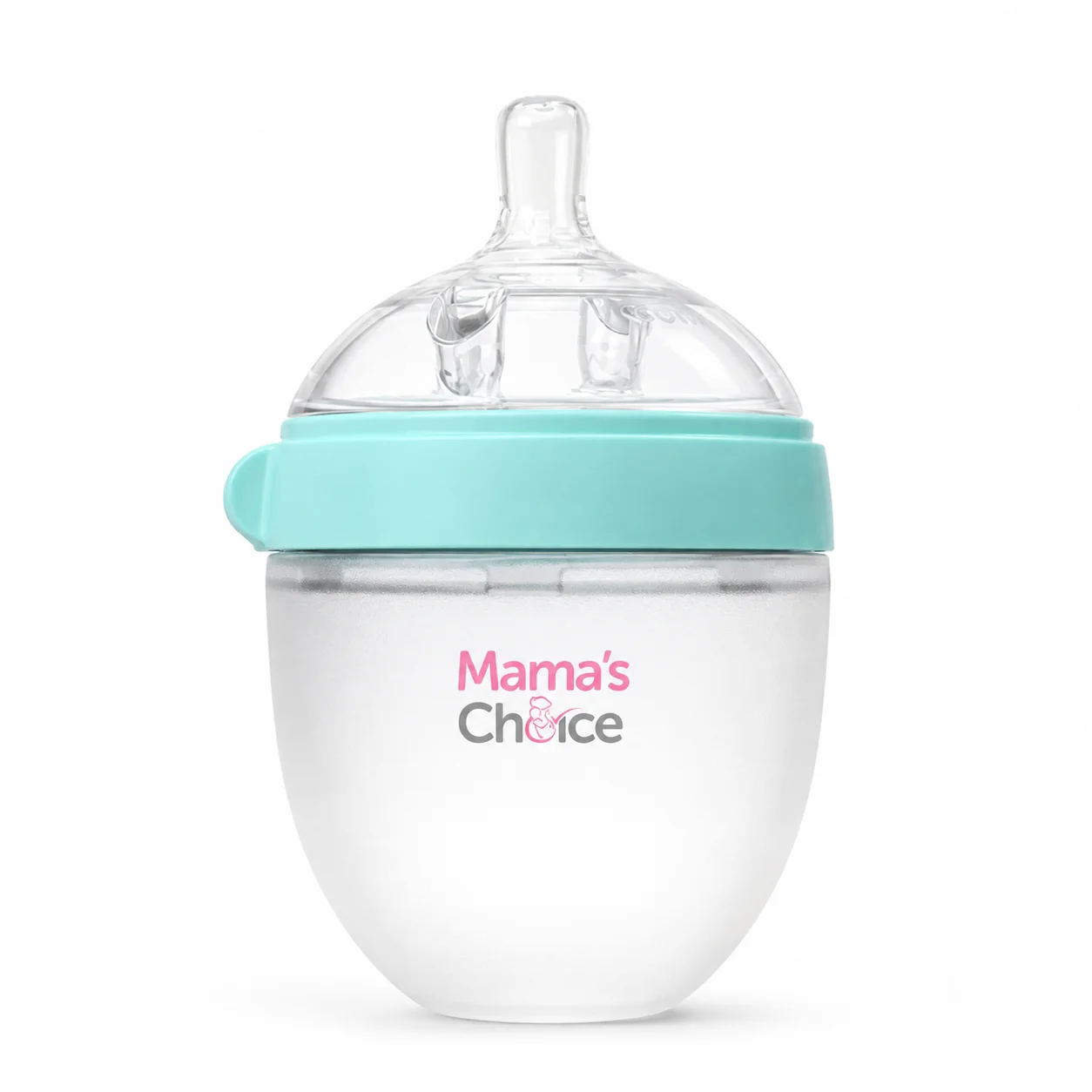
A teat she has to open wide for. Look for a wide, sloping base so she latches deeply rather than sucking the tip. An asymmetric teat, shaped to follow the roof of her mouth, like the one on the Mama's Choice anti-colic bottle, is built to sit where your nipple sits during a feed.
Slow flow, whatever her age. A breastfed baby should be on the slowest flow she is comfortable with. Let her work for it.
Paced feeding. Hold her fairly upright, keep the bottle close to horizontal, pause every few sucks. Any bottle becomes more breastfeeding-friendly this way, which matters more than the brand.
Flow, and how to know you got it wrong
- S, slow flow. Roughly 0 to 3 months, and still right for an older breastfed baby
- M, medium flow. Roughly 3 to 6 months
She will tell you before the box does. Choking, milk running out of the corner of her mouth, or drinking alarmingly fast means slow it down. Sucking hard and getting cross, or the teat collapsing, means speed it up.
Materials
Food-grade silicone suits breastfed babies best. The texture is closest to skin, it survives repeated sterilising, it is light, and it does not shatter on a tiled floor.
Glass is the most inert and the heaviest.
PP plastic is light and cheap, and goes cloudy faster with sterilising.
Whatever you pick, check the label says BPA-free, phthalate-free, PVC-free. For something heated every day, that is a requirement, not a bonus.
What "anti-colic" actually buys you
When a baby sucks on a bottle with no venting, the pressure inside pulls air in through the milk. Bubbles form, she swallows them, and they come back later as wind.
A vent gives the air its own way in, so the bottle stops fighting her suck and the bubbles stay out of the milk.
The limit, plainly: an anti-colic label does not give you a baby without colic. Venting cuts the air she swallows from a bottle, and swallowed air is only one cause of wind. Colic itself is not fully understood, and no bottle prevents it.
Preferences have moved this way anyway. In the theAsianparent Indonesia community poll on baby bottles, a media brand in the same group as Mama's Choice but run independently, our anti-colic bottle was picked by 25% of 779 Mamas in May 2022, up from 5% earlier that year (n=4,273).
The small things that matter at 3am
- Removable handles on bigger bottles, for when she wants to hold it herself
- A scale you can read without turning on the light
- A wide neck, because you will be cleaning the bottom of this every day
- Fewer parts, because you will be sterilising all of them
When to introduce one
If breastfeeding is established, most people suggest 3 to 6 weeks. Settled enough not to disturb her latch, early enough that she does not refuse the whole idea.
Offer it when she is calm rather than starving, and get someone else to give the first one. Plenty of babies refuse a bottle from their Mama, because you smell like the alternative.
When it is not the bottle
If the crying comes with a fever, repeated vomiting, blood in her stool, or she is not gaining weight, that needs a doctor rather than a different teat.
Frequently asked questions
- Which bottle avoids nipple confusion?
- No bottle guarantees it, but the risk drops with a teat that resembles the breast: a wide, sloping base, a soft texture, and a slow flow so the baby still has to suck actively rather than simply swallow.
- What age is a slow-flow teat for?
- Slow flow is usually labelled for 0 to 3 months and medium for 3 to 6. The better guide is the baby: choking or milk escaping from the corner of the mouth means the flow is too fast; sucking hard in frustration means it is too slow.
- Glass, plastic or silicone?
- Each has a place. Glass is the most inert but heavy and breakable; PP plastic is light and inexpensive; food-grade silicone is soft, handles extreme temperatures and feels closest to skin. Whichever you choose, check it is BPA-free.
Sources
- theAsianparent Indonesia community polls on baby bottles — Feb 2022 (n=4,273), May 2022 (n=779)
- Paced bottle feeding guidance for breastfed babies
Share this article
This article is for information only and is not a substitute for diagnosis or medical advice. Please discuss your own situation with your midwife or doctor.