
Teaching a Child to Feed Themselves
When to start self-feeding, ten things that make it go faster, and why the mess on the floor is evidence the lesson is working.
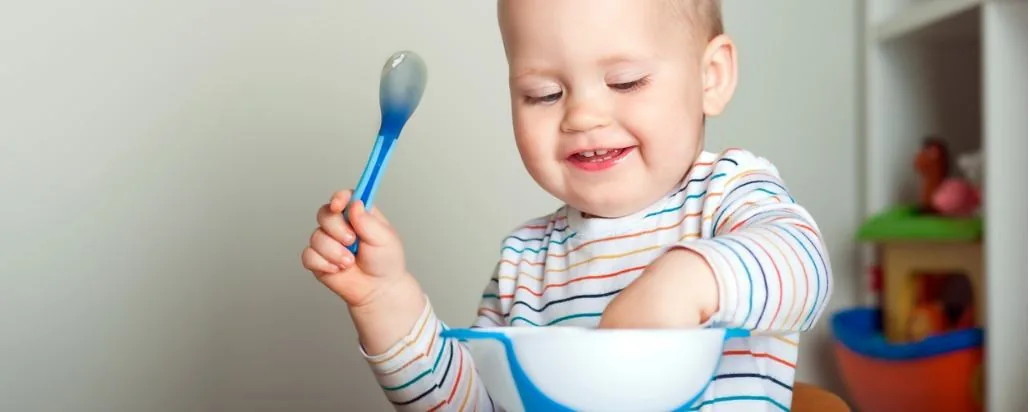
Half of it is on the floor and none of it is in her.
That is not failure, it is the lesson. Reaching, gripping, scooping, squeezing and dropping food all build fine motor skill, and exploring taste, texture, smell, colour and temperature builds her tolerance for new food.
There is a quieter benefit too. A child deciding how much goes in is learning to read her own hunger and fullness, which is a skill that outlasts the high chair by decades.
When to start
From around 6 months, or once she can sit up and swallow solid food.
Plenty of parents begin with soft textures, which make it easier for her to control the amount. Finger foods follow once that is going well.
If you are unsure about readiness, ask a doctor rather than working from her birthday.
Ten things that help
Set up before you sit down. Food ready, everything within reach, then she goes in the chair. Leaving mid-meal to fetch a spoon is how you lose her attention.
Give her chances to practise. The number of opportunities matters more than any technique. Hands and cutlery both count.
Start with hands. Before cutlery, let her get food to her mouth with her fingers. A few pieces on the tray, and let her reach, feel and grip. That is the first lesson and it is a real one.
Two spoons. One for you to demonstrate with, one for her. Children learn this by copying, and her own spoon means she can copy immediately rather than wait for yours.
A bowl that sticks to the table. A suction base keeps it where it is. Without one, moving the bowl becomes the more interesting game.
Encourage hand-eye coordination. Spearing food with a fork. Moving a cup from one spot to another. Coordination practice disguised as a meal.
Stay near her. Sit with her. You are watching how she handles new textures and how much goes in at once. Choking is a real risk at this age, and supervision is what manages it.
Expect the mess. A child allowed to touch and explore her food will make a mess of the table, and that is normal.
A bib limits the damage to her clothes. Newspaper or a plastic mat under the chair saves more effort than trying to prevent spills.
Food on the floor is evidence she tried. It gets tidier with practice.
Eat together. Watching you and her siblings use cutlery is the most efficient teaching method there is, and it asks nothing of you beyond eating at the same time.
Be patient. There is no benefit to hurrying this. She needs to set her own pace to learn what hunger and fullness feel like. It takes weeks, and it works.
Equipment that helps
It goes better when the tools fit small hands.
Jolly Silicone Feeding Set and the Silicone Baby Bowl & Cutlery Set are food-grade silicone, BPA-free and heat resistant, so they take boiling water. The spoons and forks are short, which is what makes them grippable.

Both dishwasher and steriliser safe.
A Silicone Baby Bib with a catch pocket takes most of what does not make it to her mouth.

Safety while she learns
- Always seated, never walking or lying down
- Always supervised
- No whole grapes, whole nuts, popcorn, or hard raw carrot
- Cut round foods lengthways
- Learn the difference between gagging, which is noisy and normal, and choking, which is silent
Gagging is part of learning to manage food in her mouth. It looks alarming and it is doing its job.
When to ask for help
- Coughing or wheezing during or after most meals
- Refusing whole texture categories for weeks
- Not gaining weight
- Still unable to get food to her mouth by around 12 months
- Repeated choking episodes
A doctor or a feeding therapist has answers for all of those, and none of them is a matter of trying harder at home.
Sources
Share this article
This article is for information only and is not a substitute for diagnosis or medical advice. Please discuss your own situation with your midwife or doctor.


