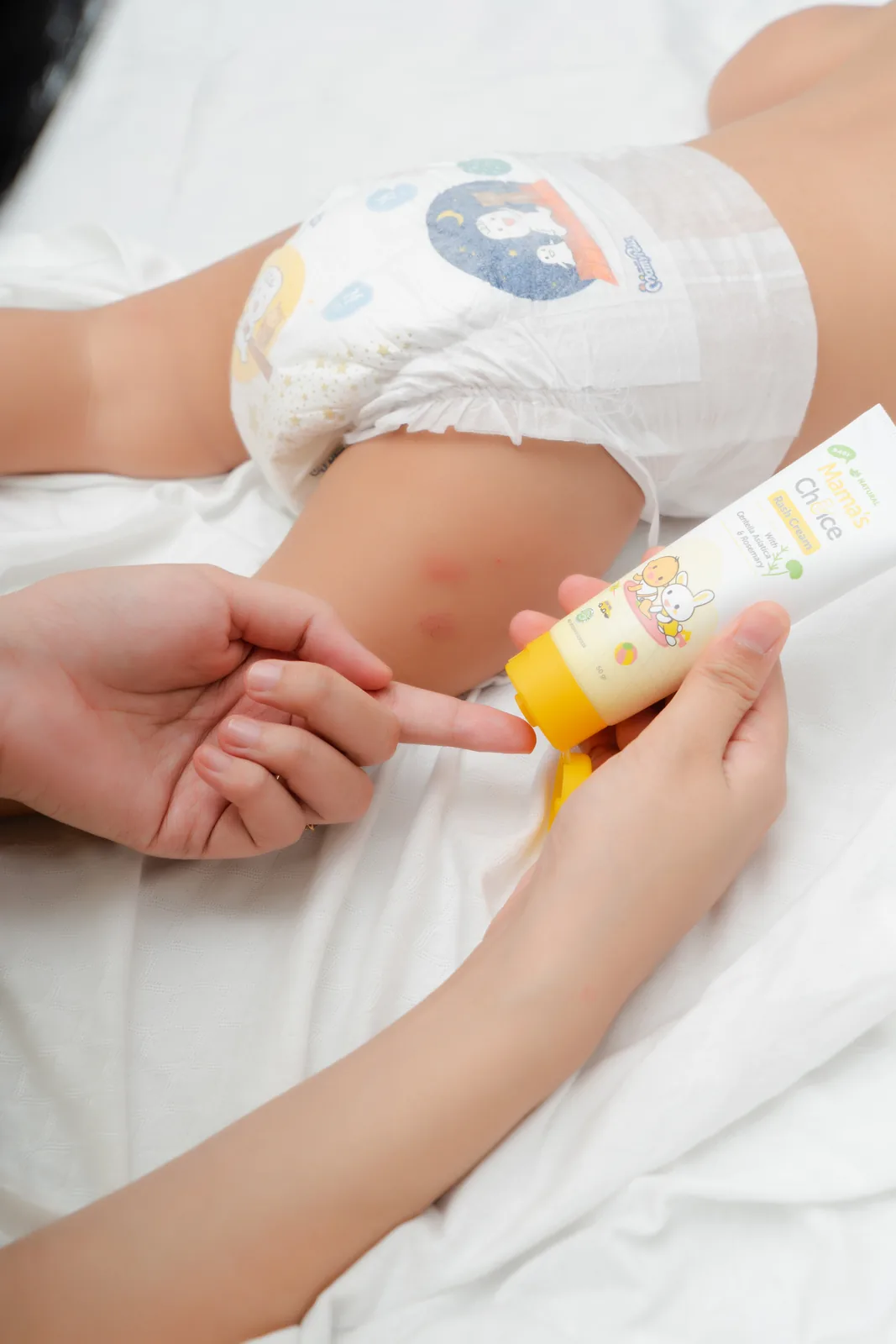
Types of Baby Rash and How to Handle Each
Nappy rash, eczema, hives, heat rash and baby acne have different causes and different answers. A guide to telling them apart at home.

Her skin is thin and reacts to friction and foreign substances far more readily than yours. Rashes in the first years are common.
Which one you are looking at decides whether the treatment works, and they look more alike than they are.

Nappy rash
Red irritated skin in the nappy area. Early, faint redness or small red dots. Worse, raised bumps spreading beyond the nappy area, with fluid or yellow crusting, which means it needs more than a cream.
Causes: friction from a nappy that does not fit, a wet or dirty nappy left too long, diarrhoea, or harsh detergent.
Eczema
Usually atopic dermatitis in babies.
Signs: itching, dryness or cracking, weeping blisters, thickened skin, redness. Most often elbows, arms and skin folds like the backs of the knees, though it appears anywhere.
Triggers: sensitive or allergic skin, weather, food, insect bites.
Care: avoiding soaps and other irritants, and moisturising consistently. For eczema that keeps coming back or is widespread, talk to a doctor rather than managing it indefinitely with moisturiser.
Hives
Triggers: infection, the most common cause in children, along with food, medicines, insect bites, and physical triggers such as temperature.
Not all hives are an allergy. Assuming they are leads parents to cut out foods that had nothing to do with it.
Signs: raised swellings, often paler in the middle, hot and stinging. Usually settles within a few days.
Heat rash
Signs: tiny itchy red spots and mild swelling on her head, neck, arms, shoulders or legs.
Causes: hot humid weather plus tightly covered clothing, which describes most of the year here.
What helps: a cooler room, a cool bath, thin clothing without layers.
Baby acne
Neonatal acne. Red skin with small red or white bumps, in around 20% of newborns.
The cause is not fully understood. Sebaceous gland activity and androgen hormones are thought to be involved, and Malassezia yeast has been linked to it, though it cannot be called the main cause.
Clears on its own within a few months, without treatment.
What to do about any of them
- Keep her skin clean and dry. Pat rather than rub
- Take away the trigger: particular foods, harsh cleaning products, friction, heat, insect bites, damp
- A safe barrier cream on irritated areas at each nappy change
- Use fewer products, not more, while skin is inflamed
A cream for irritated skin
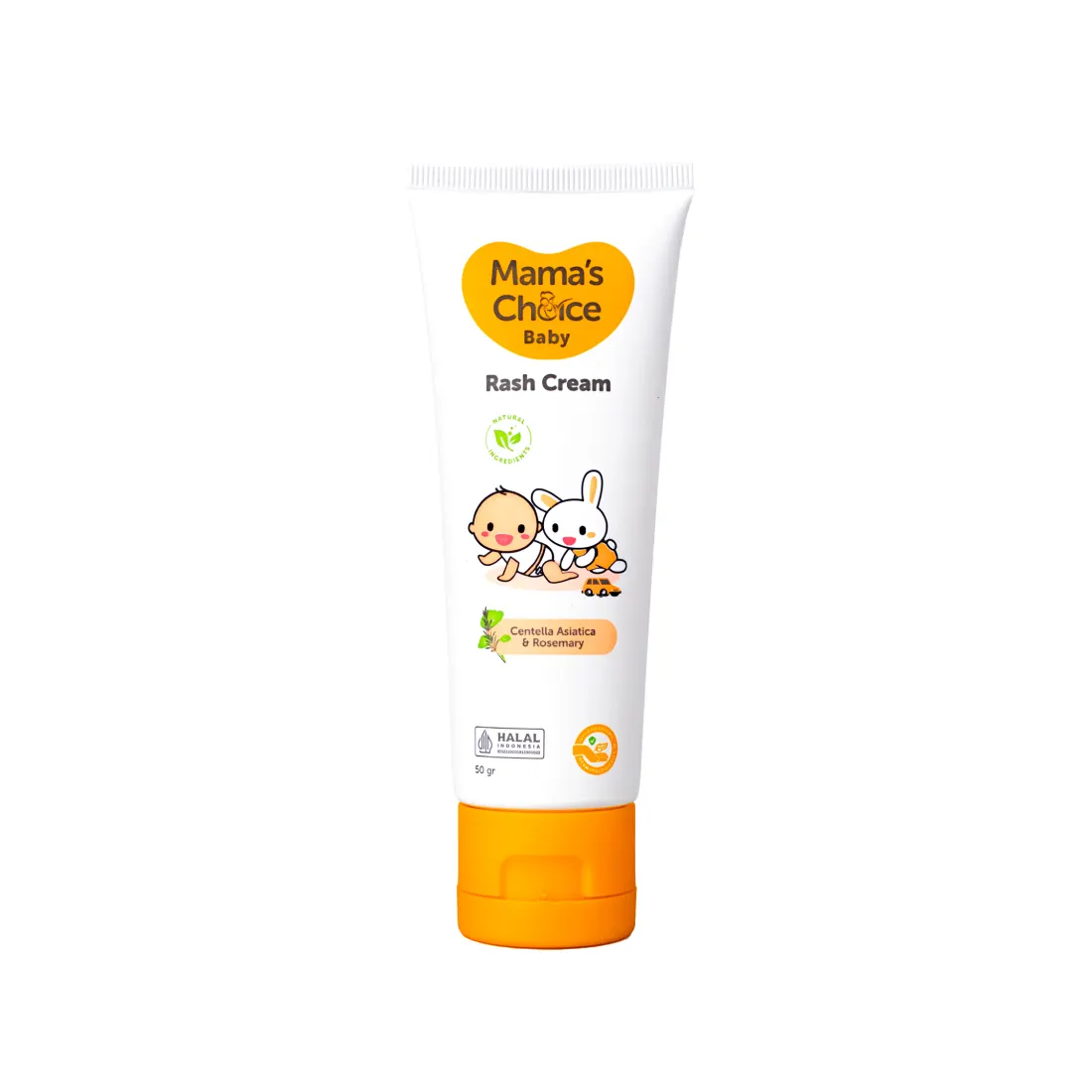
Mama's Choice Baby Rash Cream uses eight natural ingredients, one of them centella asiatica, to calm irritated skin.
Light texture, absorbs quickly, and it works across her body rather than only under a nappy.
A note on the claim: "helps ease a rash within 3 applications" comes from the Mama's Choice Efficacy Test 2021 (n=30), a use test on the finished product where participants reported improvement, not complete resolution, and which was not a controlled clinical trial.
Two more you may run into
Milk rash, which is misleadingly named. Red dry patches on her cheeks, usually eczema rather than anything to do with milk touching her skin. Changing formula rarely helps, and moisturising consistently usually does.
Drool rash, around her mouth and chin while she is teething, where saliva sits on the skin all day. Wipe gently rather than rubbing, and put a barrier on before she sleeps.
Neither needs anything dramatic. Both get treated as emergencies far more often than they deserve.
Where each one shows up
The map is genuinely useful at 6am, because location narrows it faster than appearance does.
| Where | Most likely |
|---|---|
| Nappy area only | Nappy rash, or fungal if the edge is sharp |
| Cheeks | Eczema, or baby acne in the first weeks |
| Elbow and knee creases | Eczema |
| Neck, shoulders, back | Heat rash |
| Around the mouth | Drool rash |
| Moving around her body | Hives |
A rash that moves is almost never eczema. A rash confined to one crease almost always is.
When a cream is the wrong answer
A barrier cream works by forming a layer on the skin. That helps an irritant rash, the most common kind, and does nothing for several of the others.
See a doctor if:
- It does not improve within a few days, or spreads
- There are blisters, open sores or pus
- It comes with a fever, particularly in a baby under three months
- The skin around it is swollen and hot
- She is unsettled and feeding poorly
Fungal rash, bacterial infection and severe eczema all need different treatments. More barrier cream in those cases only delays the right one.
Sources
- Cleveland Clinic — Diaper rash (diaper dermatitis)
- Mayo Clinic — Atopic dermatitis (eczema)
- NHS — Hives (urticaria)
- Mama's Choice Efficacy Test 2021, n=30
Share this article
This article is for information only and is not a substitute for diagnosis or medical advice. Please discuss your own situation with your midwife or doctor.