
Household Cleaners Safe Around Babies: What to Check
Which cleaning ingredients are worth avoiding around a crawling baby, how to ventilate properly, and the difference between cleaning and disinfecting.
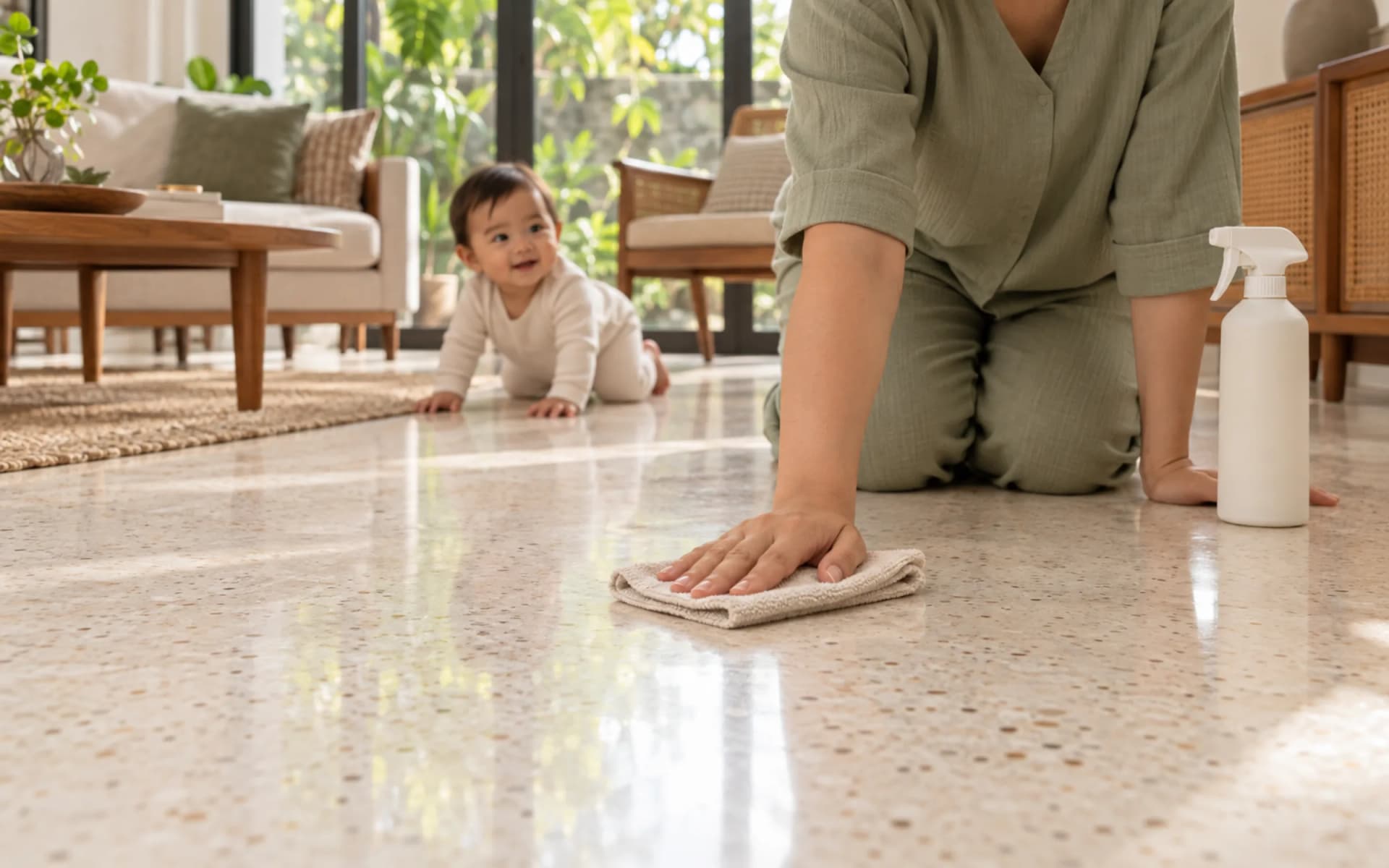
She started crawling this week, which means her face now spends the day a few inches from your floor and her hands go straight into her mouth afterwards.
Which makes what you clean that floor with a more relevant question than it was a month ago.
Cleaning and disinfecting are two different jobs
This distinction does most of the work, and almost nobody makes it.
Cleaning removes dirt and most germs with soap or detergent and water. It is what a floor, a table and a toy need nearly all of the time.
Disinfecting kills germs with stronger chemicals. Worth doing on surfaces that met raw meat, vomit or faeces, and during an illness in the house.
Disinfecting everything every day is not more hygienic. It adds chemical exposure without adding benefit, and it is how a household ends up with more product in the air than it needs.
What to avoid around her
Ammonia and chlorine bleach, especially in a room with no ventilation. Never mix the two. It produces a toxic gas.
Strong fragrance. Air fresheners and heavily scented cleaners are a common source of indoor irritants, and fragrance is where phthalates hide.
Quaternary ammonium compounds in some disinfectant sprays, which irritate airways.
Aerosols generally, which put fine droplets into air she then breathes.
Where you genuinely need something stronger, use it, open the windows, and keep her elsewhere until the surfaces are dry.
What to look for instead
- A short ingredient list you can actually read
- Fragrance-free, or lightly scented at most
- Something that rinses cleanly, particularly for floors
- Liquids and wipes rather than aerosols
- Storage out of reach, cap on
One thing not to trust: "natural" and "food grade" are not safety guarantees. Food grade describes suitability for contact with food in manufacturing, and says nothing about whether a cleaning product is safe to swallow. Plenty of plant-derived ingredients irritate skin and airways.
What decides safety is the formulation and how you use it, not the word on the front.
Habits that matter more than the product
Open the windows while you clean and for a while afterwards. In an air-conditioned room, that means turning it off and opening up rather than recirculating.
Let floors dry completely before she goes down on them. Wet floors are slippery and still carrying whatever you used.
Clean while she is out of the room, or asleep somewhere else.
Rinse toys that go in her mouth with plain water after cleaning them.
Lock everything away. Cleaning products are among the most common causes of accidental poisoning in small children, and the cupboard under the sink is precisely where a crawling baby heads first.
Mosquito coils and air fresheners
Both put particles into indoor air, and both are worth reconsidering in a room where she sleeps.
For mosquitoes, a net over the cot and screens on the windows add nothing to the air at all. If you do use a coil or spray, light it well in advance, ventilate, and wait until the smoke has cleared before she comes back in.
What actually needs cleaning, and how often
Most households clean the wrong things too often and the right things not enough.
Daily. Floors where she crawls, her high chair tray, and anything she has been chewing. Soap and water is enough for all of it.
After every use. Anything that touched raw meat, eggs or fish. This is where disinfecting genuinely earns its place.
Weekly. Door handles, light switches, the fridge handle, taps. The places hands land repeatedly.
When someone is ill. Bathroom surfaces, and anything shared, more often and with something stronger.
Rarely. Walls, curtains, soft furnishings. These get cleaned on a schedule in a lot of homes and almost never need it for hygiene.
Her toys
Hard plastic toys go in warm soapy water, then rinse and air dry. Nothing stronger is needed for everyday use.
Fabric toys go in the washing machine on a hot cycle, with the same fragrance-free detergent you use for her clothes.
Dummies and teethers get washed after they hit the floor, and sterilised only in the first few months or after an illness. Beyond about six months, washing is enough. The sterilising of everything, forever, is a habit rather than a requirement.
Skip antibacterial wipes on things she puts in her mouth. You are leaving residue on a surface headed straight for her tongue, to solve a problem soap already solved.
Ring a doctor if
- She has swallowed any cleaning product, however little
- Anything splashed in her eyes
- Coughing, wheezing or breathlessness after fumes
- Skin that is red, blistered or painful after contact
Do not make her vomit after she has swallowed a cleaning product. Take the bottle with you, so whoever treats her can read the ingredients.
Sources
Share this article
This article is for information only and is not a substitute for diagnosis or medical advice. Please discuss your own situation with your midwife or doctor.